
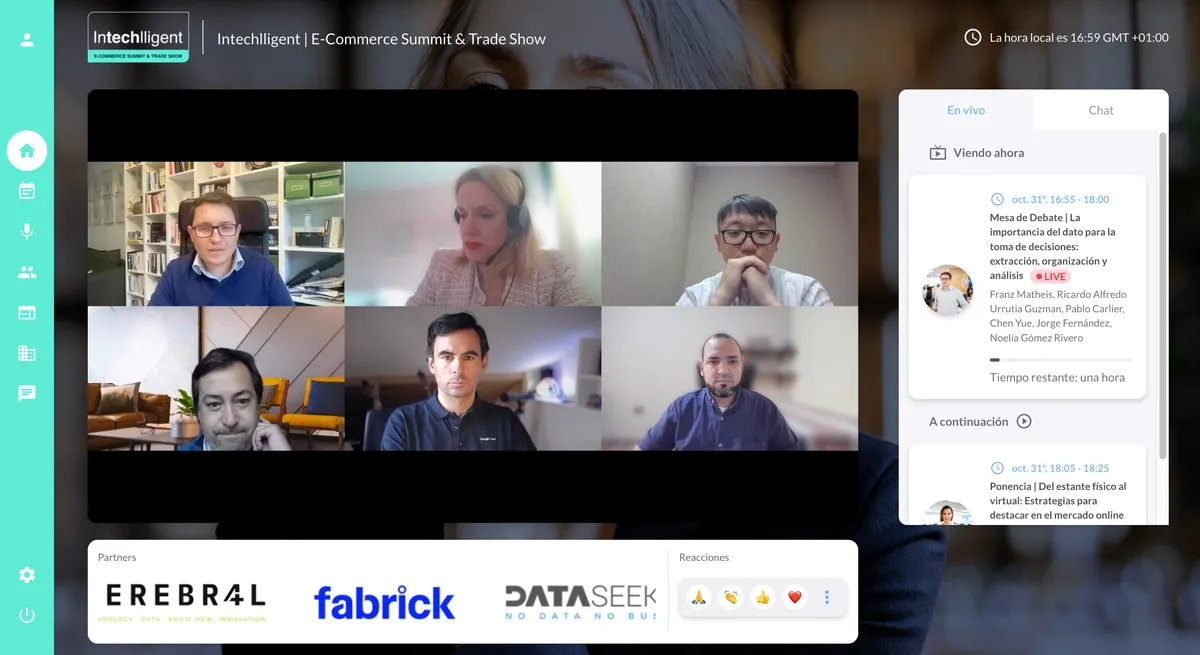
Intechlligent: E-commerce Summit & Trade Show, organised by Data Seekers, was recently held as a key meeting point for professionals and experts in e-commerce, technology and innovation. It brought together more than 250 attendees, more than 60 one-to-one meetings were arranged between buyers and vendors, and more than ten major companies from the e-commerce scene took part to exchange ideas on the latest trends, pricing strategies, artificial intelligence, Big Data and other developments in e-commerce.
Within this event, the panel discussions proved to be a fundamental way to share knowledge, experience and perspectives on the current challenges and opportunities in e-commerce.
Panel 1: Innovation and strategy in e-commerce, keys to success in pricing and distribution
A space dedicated to innovation and strategy in e-commerce, addressing crucial aspects such as price management, product distribution and sales campaigns at key moments such as Black Friday and Christmas, moderated by Georgina Ortiz, editor-in-chief at Ecommerce News. The panellists, from brands such as Mattel, Nestlé, Kimberly Clark, Grupo Unicomer and Data Seekers, shared their experience and recommendations on how to prepare for each of these commercial opportunities.
Lorena González, Senior Manager Digital Operations EMEA at Mattel, pointed out that for the leading multinational in the toy world “the most important one is Christmas”, stressing the need for advance planning to ensure products are well positioned, both in retailers’ catalogues and on online product pages. For Nestlé, on the other hand, events such as Black Friday and Christmas are crucial for several product categories, said Víctor de la Fuente, Global eCommerce Digital Shelf Lead and Retail Digital Media at the company.
René Colorado, Vice President of Merchandise CMO at Grupo Unicomer, representing the retail sector on the panel, stressed that for them planning for these campaigns starts up to a year in advance, noting that “a season represents approximately 40% of the year” for retailers. Most of the success in sales lies in good planning.
From a more technical perspective, Curro Pavón, Chief Technology Officer at Data Seekers, emphasised the need for a well-defined pricing strategy before key events such as Black Friday. Retailers are increasingly interested in monitoring the competition, so “we cannot stop at general KPIs, we need to go further and look for the more specific ones. Each sector has its own KPIs, and even within the same sector the indicators can vary depending on whether we are measuring on Amazon or on another retailer. Knowing the specific needs of each brand is key to making informed decisions,” Curro explained.
Finally, María Suárez, eCommerce Manager at Kimberly Clark, highlighted the importance of Amazon as a sales channel because of its wide reach, but warned of the need to diversify sales and not depend exclusively on a single platform. “We can’t put all our eggs in one basket,” she said. Víctor de la Fuente added that some brands choose not to be on Amazon due to brand protection concerns, while others prefer to select trusted sellers to operate on the platform, making sure the customer experience is under control.
Panel 2: Big Data, Artificial Intelligence and decision-making
The second Intechlligent round table focused on Artificial Intelligence and Big Data in business decision-making, a crucial topic for companies seeking to improve their operations in an increasingly competitive and digitalised market, moderated by Jorge Fernández, Customer Success Manager at Marketing4Ecommerce.
Opening the debate, Noelia Gómez, Sales Director at Fabrick, revealed significant figures on transaction losses in Spain: “20% of transactions are lost, of which 7% is fraud and 13% is configuration problems.”
The picture Noelia painted confirms the need for effective data management to reduce these losses and keep transactions flowing. In this context, Franz Matheis, CEO and co-founder of Data Seekers, emphasised that in today’s environment companies must be able to react quickly. According to Matheis, decisions must be based on real-time data in order to adapt nimbly to market changes and seize the opportunities that arise.
Chen Yue, Head of Digital at Laboratorios Phergal, pointed out that for small and medium-sized companies the key is to “select and manage the right data” to optimise performance and respond efficiently to market demands. In line with this idea, Pablo Carlier, Head of Data Analytics & AI Sales Iberia at Google Cloud, shared his vision of the evolution of unstructured data and how it combines with artificial intelligence to improve processes. Ricardo Urrutia, Data Tech Lead at Cerebr4l, addressed the democratisation of Big Data: “today any company, regardless of its size, has access to this powerful tool.”
The panel then moved on to the ethical challenges of using Artificial Intelligence, stressing the importance of guaranteeing data privacy and the need for human supervision to prevent automated processes from producing unwanted results. Companies must keep a balance between automation and human control to ensure responsible and effective results.
As for advice for companies starting out with Big Data and AI, the experts agreed that this is a gradual process that requires patience. Understanding what data you have and what you lack is a fundamental step towards optimising operations. Companies also need to understand how to use the data available to improve their results and stay competitive.
Takeaways
Intechlligent: E-commerce Summit & Trade Show, organised by Data Seekers, offered a complete perspective on the impact of Big Data, AI and the key platforms for competitive pricing, as well as how to stay ahead of the market. The panel discussions were an ideal space to learn from experts and share best practices, giving companies valuable tools to face market challenges and take advantage of the opportunities offered by new technologies.
Want to reach the next Black Friday with a defined, measurable pricing strategy? Discover our pricing intelligence solution.