Catalogue
Products and attributes
Names, references, attributes, variants, formats and categories, so you know what is sold on every channel.

Proprietary web scraping infrastructure, artificial intelligence for data quality and an obsession with reliability. That is how we build the foundation our platforms run on.
Why it matters
Web scraping extracts public information from websites automatically and turns large volumes of data into structured knowledge. In e-commerce, collecting is not enough: you have to validate it, organise it and put every signal at the service of a decision.
Monitor prices and promotions to spot relevant changes at the right moment.
Analyse catalogues, stock and product presence across retailers, categories and markets.
Identify competitor moves and new market signals before they take hold.
Align catalogue and digital shelf decisions with verified, actionable information.
Beyond price
We analyse the information that appears online so you know what products are out there, how they are shown, whether they are available and what your competitors are doing. We monitor prices, promotions, catalogue, availability and product presence so your team can prioritise actions.
Catalogue
Names, references, attributes, variants, formats and categories, so you know what is sold on every channel.
Visibility
Position, presence and product content on every retailer and market: the real digital shelf.
Availability
Stock, unavailable products and changes that can affect sales and conversion.
Competition
Prices, promotions, launches and relevant changes that anticipate new opportunities in the market.
Clients
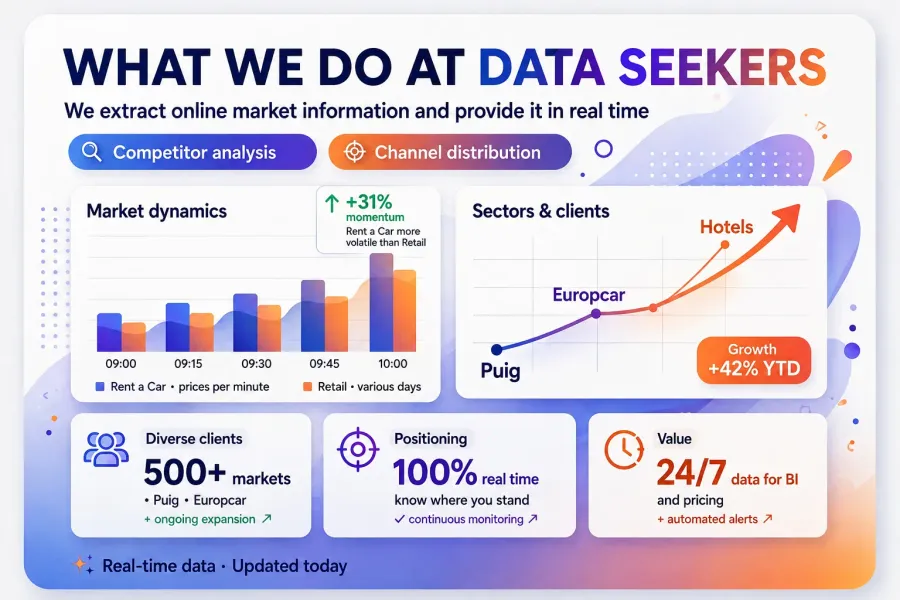
We adapt capture to organisations with different scales, markets and commercial intelligence needs, and we turn digital complexity into a clear, up-to-date reading that is useful for the business.
Sectors
Teams in e-commerce, FMCG, toys, fashion and other sectors can read their competitive environment better.
Real time
Spot relevant changes as they happen and turn every update into a business opportunity: real-time data for decisions that move forward.
From extraction to action
At Data Seekers we do not apply the same way of working to every case: we analyse the sources, the markets and the goals of each client to design a process adapted to what they need to monitor. Architecture, quality and speed in a single flow.
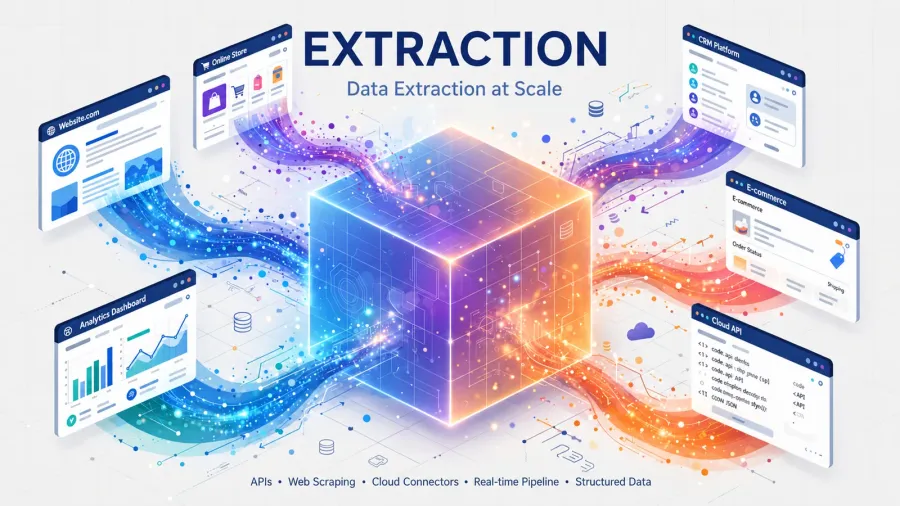
Phase 01 / Extraction
We analyse public sources and their structures to build a capture strategy adapted to the use case.
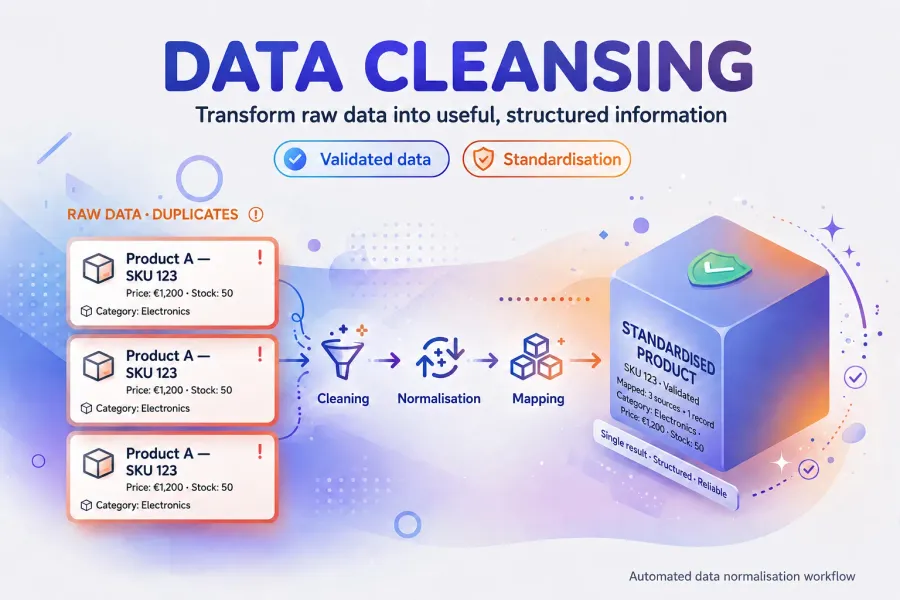
Phase 02 / Data cleansing
We normalise, enrich and validate every dataset so that it answers the specific needs of your business.
Phase 03 / Action
Insights become an operational base for acting quickly on pricing, assortment, availability and strategy.
The technical challenge of scraping
E-commerce environments never stand still: catalogues that are refreshed, sites that are redesigned and content generated on the fly. Traditional scraping is not enough when the goal is to keep quality, continuity and scale.

In e-commerce, power is not simply in having data, but in having it sooner, better and more reliably than everyone else.
Francisco Pavón Ocete, Co-founder and CTO of Data Seekers
The technology behind it
We combine automation, quality control and observability so that every source can become a useful business signal. The technology adapts to the context, not the other way round.

CAPTURE
We design specific access for static and dynamic structures and for catalogues that change constantly.
QUALITY
We detect anomalies, duplicates and structure changes before they affect your analysis. Our QA team reviews every alert the automation opens.
SCALE
We organise large volumes of information to keep consistency, speed and traceability.
VISIBILITY
We turn relevant changes into clear information for prioritising the next decision.
The QA team
Your decisions on price, stock, catalogue and visibility depend on the information being right. That is why our QA team does not just check that the capture runs: it reviews how the data changes and confirms that it reflects the reality of the market.
The technology detects that something does not add up. The team works out what may be happening and decides how to act.
We run automatic checks that detect when a piece of data fails to meet the established quality criteria. If something does not add up, an alert is raised for the QA team to review before it can affect an analysis or a decision.
We compare each capture with the previous information to confirm what has changed.
The team analyses whether it is a technical incident or a real change at the source.
The review is continuous, every day and across every monitored source.
We keep its origin and its history so it can be checked whenever needed.
The result
Our technology is designed so that every dashboard, alert or report has a reliable, complete and scalable foundation behind it.
You know what the competition is doing as it happens, not weeks later.
Adjust prices with solid, current and comparable references.
From a single category to millions of products, reviewed daily.
Your team has the data when it needs it and knows where to start.
Data Seekers turns access to complex information into a strategic asset for your business.
Frequently asked questions
We detect it before you do. Our QA team compares every capture with the previous ones, and when something stops adding up the first question is not how to fix it but why it changed: a bug in our code and a redesign of the source site look very similar in the data, but they are resolved in completely different ways. If the site has changed, the scraper is adapted to the new structure and the change is documented.
Daily. The review is not triggered when something breaks: it is continuous work by the QA team across every scraper, precisely so that problems are caught before they reach your analysis.
By comparing. Every capture is checked against the history of that same source to find what has stopped adding up: an incomplete catalogue, a price that is not the one shown on the site, duplicates from product variants, or formats that are no longer what they should be.
No, and that is deliberate. Automation captures, validates and raises alerts; the QA team reviews every alert that automation opens, keeps each field mapped to its source and documents every scraper and every change. Some decisions, such as telling a bug of ours apart from a change at the source site, still need human judgement.
That is part of the job, not an exception. The most mature environments have complex architectures that load through JavaScript and catalogues that change daily. It is solved by readapting the connector to the new structure, with responsible access so the site is never overloaded, and by covering each market separately.
Tell us your case and we will show you how we would work with your team