
Retail · For Retailers ·
Module 01 · Pricing Intelligence
Pricing Intelligence Know at all times how you stand against the market and act before the competition
Pricing Intelligence
Know where you are losing competitiveness before it shows up in your conversion.
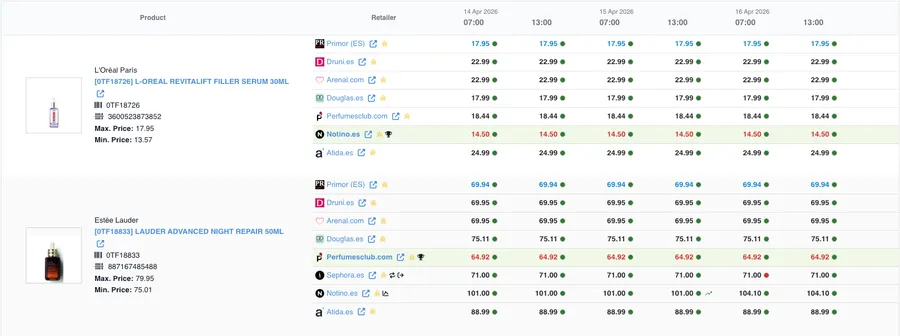
All your competitors' prices captured up to every hour. Detect who moves first, identify where you are losing competitiveness and make pricing, promotion and negotiation decisions with real data.
Capture up to hourly
All your competitors' prices, with full history.
Multi-retailer comparison
Your price against every competitor on the same SKUs.
Global analysis
A consolidated view by country, category and competitor.
Qué incluye
Pricing Intelligence, en detalle
-
Hourly price capture
Across your direct competitors.
-
Beat / Meet / Lose
By SKU, category and brand.
-
First mover detection
Who started each movement and who followed.
-
Alerts in your own channels
Telegram, email, Slack and webhooks.
-
Full price history
By SKU, retailer and market.
-
Promotions and out-of-range changes
Detected across the competition, with discount and period.
The price you set today could be the reason your customer buys from another site tomorrow
In ecommerce, the price difference between retailers is visible in seconds. A consumer compares, chooses and leaves, without warning. Data Seekers captures all your competitors' prices up to every hour, with a complete history and alerts through the channels your team already uses.
Features
Seven pricing intelligence tools for retailers
All your competitors' pricing context in one place: who moves, by how much and since when.
Price Benchmarking vs. Competitors
Compare your price against other retailers on the same SKUs, categories and markets. Track the market's average, minimum and maximum price.
Beat / Meet / Lose by SKU, Category and Brand
See at a glance which products you're pricing below the market (Beat), matching it (Meet) or above it (Lose). An actionable view that lets you prioritise where to adjust price, where to launch a promotion and where you have room to hold.
| Retailer | SKU | Price | vs. Market | Status |
|---|---|---|---|---|
| Your site | Product X | 29.90€ | +8% | 🔴 Lose |
| Competitor A | Product X | 27.50€ | Market ref. | 🟡 Meet |
| Competitor B | Product X | 26.90€ | -2% | 🟢 Beat |
| Competitor C | Product X | 29.90€ | +8% | 🔴 Lose |
| Competitor D | Product X | 24.50€ | -11% | 🟢 Beat |
🟢 Beat = price below market · 🟡 Meet = reference price · 🔴 Lose = price above market.
First Mover Detection
Identify which retailer initiated each price movement, on what date and by how much. Know who sets the pace in each category and anticipate movements before they affect your conversion.
Alerts Through the Channels Your Team Already Uses
Receive real-time notifications via email, Telegram, Slack or webhook when a competitor changes price, when a relevant promotion is detected or when an out-of-range change occurs.
Complete Price History
Access the complete history of price evolution by SKU, retailer and market. Analyse trends, detect recurring promotional patterns and build solid arguments for negotiating with brands.
Intelligent Repricing
Create rules for dynamic price adjustment based on competitors' movements. Monitoring frequency is configurable, from multiple daily captures to weekly tracking.
To automate repricing execution, see Dynamic Pricing & Repricing →
Promotion Detection and Out-of-Range Changes
Track when and where competitors activate promotions, in which categories and for how long.
Knowing who is cheapest is not enough.
To make effective pricing decisions you need to know how big the gap is, how it has evolved, whether there are active promotions and in what category and market context it is happening. Price is information, but the value lies in interpreting it.
What it includes
Pricing Intelligence for Retailers, in detail:
A complete view of the market in one place, with the key information to make better decisions.



How it is used
How retailers use pricing intelligence to make decisions ahead of the competition
It's not just about knowing a competitor is cheaper. It's about knowing when they dropped, how long it's been that way, whether others followed, and deciding whether to adjust, promote or hold. With context, not intuition.
From market data to a commercial decision.
Turn information into action with a simple, clear process built for your team's day to day.
- 1 Spot the SKU out of market Quickly identify where you are above or below the market.
- 2 Understand price, promotion and category Analyse the full context before deciding.
- 3 Decide whether to compete, hold or protect margin Make decisions aligned with your commercial objectives.
A clear view for each team.
- Ecommerce Spot pricing opportunities across your assortment and improve your competitiveness.
- Pricing Get a complete view of the market to make pricing decisions with context.
- Management Know your competitive position by category, market and retailer, and decide with data.
A Digital Director at an electronics retailer identified that in three key categories their prices were systematically above the market, not by policy, but due to lack of visibility. Using Data Seekers data, they prioritised the SKUs with the greatest impact on conversion and negotiated supply conditions with brands that allowed them to adjust prices without sacrificing margin.
Lo que este módulo cambia en tu día a día
You know who moves first
Which competitor started each price movement, on what date and by how much, and who followed.
You decide with context
Beat, Meet or Lose by SKU, category and brand: where to adjust price, where to launch a promotion and where you have room to hold.
You negotiate with brands using data
Full history by SKU and category to ask for supply terms with arguments, not impressions.
FAQs
Frequently asked questions about pricing intelligence for retailers
Why is it important to monitor competitors' prices in ecommerce?
In ecommerce, price is one of the most immediate decision factors for the consumer. A visible price difference between retailers can divert traffic and conversion within hours. Continuous monitoring allows you to detect competitors’ movements in real time, anticipate market changes and make pricing, promotion and negotiation decisions with full context, not with intuition.
What does Beat / Meet / Lose mean and how is it used?
Beat / Meet / Lose is an actionable classification that indicates the price position of each SKU relative to the market. Beat means you are below the market reference price, a strong competitive position. Meet indicates you are matching that reference price. Lose signals you are above it, a possible conversion barrier. This view allows you to prioritise where to adjust price, where to launch a promotion and where you have room to hold, by SKU, category or full brand.
How often are competitors' prices captured?
Data Seekers adapts to each client's needs: data collection can be configured up to several times per hour, daily or a set number of days per week. For high-turnover SKUs or high-demand periods, it makes sense to increase the frequency. For more stable categories, a daily or weekly collection may be sufficient. Frequency is the client's decision, not a platform limitation.
Can I know which retailer initiated a price movement?
Yes. Data Seekers identifies the first mover: the retailer that changed the price first, on what date and by what magnitude. It also shows which other competitors followed the movement and how quickly. This allows you to distinguish between a price leader that sets the market pace and a reactive follower, key information for deciding how to respond.
Through which channels do price change alerts arrive?
Alerts arrive via email, Telegram, Slack and webhook, the channels your team already uses. There is no need to review dashboards manually: when there is a relevant movement by a competitor, the notification arrives directly where your team works.
How does the module help with brand negotiations?
With historical price data by SKU and category, the buying team can identify which products are systematically above the market, what impact that is having on conversion and what supply conditions would be needed to adjust prices without sacrificing margin. It is the strongest argument in a negotiation with a brand.
Does the system detect competitors' promotions?
Yes. Data Seekers tracks when and where competitors activate promotions, in which categories, with what discount level and for how long. It allows you to detect recurring patterns, for example, systematic price drops ahead of a seasonal campaign, and anticipate them with enough time to prepare a coordinated response.
In which sectors and markets does Data Seekers operate?
Data Seekers works with retailers in sectors such as beauty, health, wellness, pharma, FMCG, electronics and fashion, with coverage in markets worldwide. The module adapts to the number of SKUs, competitors and markets each retailer needs to monitor.
How does Pricing Intelligence integrate with other Data Seekers modules?
Pricing Intelligence works independently: each client accesses and pays only for the modules they need. If additional modules are added at any point, the data crosses natively and appears in a single dashboard. For example: if a competitor lowers the price of a SKU and that same SKU has better stock availability than yours, you can see both signals together and decide whether the problem is price, stock or both, without crossing reports manually.
Do you know how many SKUs you have today priced above your competition?
Request a demo and in less than 30 minutes we'll show you how your price compares to the rest of the market in your relevant product categories and against the competitors that matter most to you.