
Retail · For Retailers ·
Module 05 · Catalogue
Catalogue benchmarking Know what your competitors have on the shelf and which opportunities you are missing.
Catalogue Benchmarking
A competitive assortment is decided with market context.
Data Seekers compares your assortment against the reference retailers in each category and market. Identify which brands are gaining presence at competitors, spot gaps in your own catalogue and make buying decisions with real market data.
Assortment benchmark
Your catalogue against more than 500 monitored retailers.
Gaps and opportunities
Which references and brands the competition has and you do not.
Market evolution
Additions, removals and share by brand, updated daily across more than 20 markets.
Qué incluye
Catalogue Benchmarking, en detalle
-
Full catalogue of every competitor
Updated daily.
-
New products at competitors
Detected from day one.
-
Gap analysis
Which SKUs the competition has and you do not.
-
Exclusive SKUs
What you sell that nobody else has.
-
Delisting alerts
Plus assortment depth by category.
-
Share by brand
Which brands dominate each catalogue.
Without online assortment analysis, your buying decisions are flying blind
A rival retailer may be offering many more references in a key category and you have no way to quantify the gap. Without an independent market mirror, it's hard to know if your assortment is truly competitive or if you are over-indexed on some brands and absent in others that competitors are already prioritising, and when a brand launches a SKU that's already gaining traction with competitors, you arrive late if you're not monitoring it.
Features
Four tools to optimise your catalogue with competitive assortment intelligence
Assortment benchmark, brand share, gaps and dashboards: competitive assortment intelligence for the buying team.
Assortment benchmark vs. competition
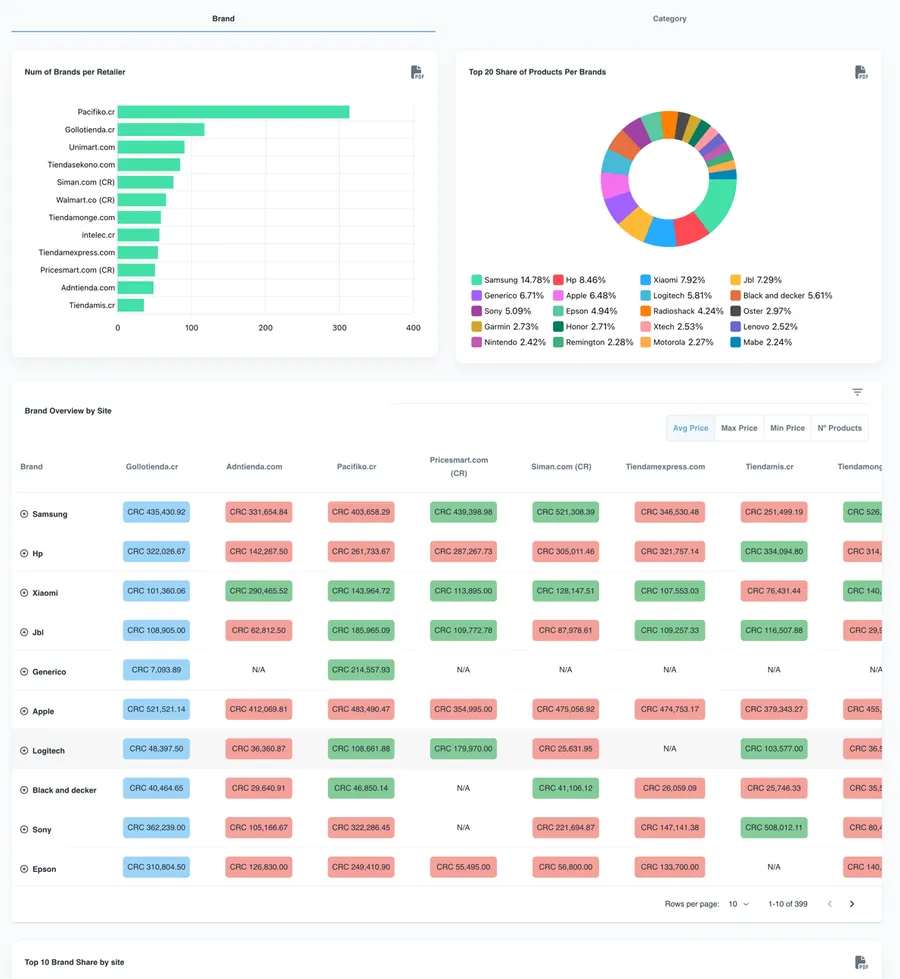
Compare your catalogue against benchmark retailers in each category and market. See how many references each competitor has, which brands they prioritise and how their assortment evolves week by week.
| Retailer | References listed | Active brands | New additions last month | Relative position |
|---|---|---|---|---|
| Your retailer | 312 | 28 | 4 | - |
| Retailer 1 | 487 | 35 | 22 | +175 refs. |
| Retailer 2 | 401 | 31 | 11 | +89 refs. |
| Retailer 3 | 298 | 24 | 3 | -14 refs. |
| Retailer 4 | 276 | 22 | 1 | -36 refs. |
Highlighted insight: Retailer 1 lists 175 more references in this category and added 22 new products last month. Brand X appears in 3 of your 4 main competitors and is not yet in your catalogue.
Brand and category share
Identify which brands dominate competitors' assortment and what percentage of their total catalogue they represent. Detect brands gaining market presence before they become a demand you cannot meet.
Gap detection and incorporation opportunities
Discover which references your competitors have that you don't list. Prioritise catalogue additions based on real market data, not on what each supplier proposes.
Personalised dashboards and data export
Configure the view your buying or category team needs. Filter by supplier, category, market or retailer. Export with one click to feed your internal planning processes.
Build an assortment that competes in every category.
Compare your catalogue with other retailers and marketplaces. Spot missing references, brands and categories to prioritise assortment opportunities with market data.
Knowing how many references you have is not enough. You need to understand which brands, categories and new arrivals are present in the channels you compete with.
What it includes
Catalogue benchmarking for Retailers, in detail:
The depth of each competitor, the gaps in your catalogue with their priority and how the market moves, in one place.
How it is used
From an assortment gap to a category decision.
A gap in the catalogue is not a list of missing references: it is a buying decision waiting to be made. Data Seekers tells you where the gap is, how much it weighs in the market and whether it is worth covering, so the meeting with the supplier starts with data.
- 1 Compare the marketAnalyse your assortment against retailers and marketplaces in the categories you care about: how many references and brands each one has and how many you have.
- 2 Locate the gapIdentify which references, brands or categories are at competitors and not in your catalogue, and at how many competitors they appear.
- 3 Prioritise the opportunityAssess the potential of each gap with market data (presence, new arrivals, evolution) to define your next steps with each supplier.
Assortment evolution, at a glance.
Review the market changes to prepare categories and campaigns with more context: how many references come in, how many go out and which brands share the catalogue.
A category manager found that a niche brand was listed at three of their four main competitors and adding references every month, while being absent from their own catalogue. With the brand's market share and its recent additions on the table, they negotiated the listing with the supplier ahead of the Christmas campaign, instead of finding out through their customers' empty search results.
For a complete view of your market, combine it with: Stock Intelligence · Pricing Intelligence
For the teams that decide what gets sold
Head of Procurement
Negotiate with suppliers from a position of information. Go into every meeting knowing what your competitors have listed, which brands are gaining shelf space and which references you should be adding.
Category Manager
Optimise the mix of each category with real data. Detect over-indexations, absent brands and differentiation opportunities versus the competition. Make assortment decisions backed by what is happening in the market, not just what local teams report.
Commercial Director
Build assortment strategy based on competitive intelligence. Monitor the assortment evolution of the main players in your sector. Identify trends before they become obvious and position your catalogue one step ahead of the competition.
Lo que este módulo cambia en tu día a día
You quantify the gap
How many references and brands each competitor holds in each category, and how many you are missing, week by week.
You buy on data, not on pitches
You prioritise additions by what is already gaining traction in the market, not by what each supplier proposes.
You get there first
You spot brands and references gaining presence at competitors before they become a demand you cannot meet.
FAQs
Frequently asked questions about catalogue benchmarking for retailers
What type of retailers can we use as benchmarking references?
Any online store: pure players, retailers, marketplaces and physical stores with a web presence. You can use international retailers to anticipate trends.
Does the analysis distinguish between permanent assortment and seasonal references?
Yes. Data Seekers records the first detection of each reference and lets you identify whether a product has been in the catalogue for months or appeared temporarily.
Can I see which specific brands competitors are prioritising?
Yes. The analysis shows the share of each brand within each competing retailer's catalogue.
Can I know when a competitor added a specific reference?
Yes. Data Seekers records the first time a product is detected on each website.
Does it work for categories with highly changing catalogues?
That is precisely where it delivers the most value. The daily update allows you to detect movements before they consolidate.
Can I cross assortment data with other metrics such as prices or visibility?
Yes. Data Seekers integrates catalogue, prices, stock and visibility on a single platform.
Is the data exportable to feed our internal systems?
Yes. Exportable in the most common formats, integrable with BI or ERP.
Is there a minimum number of categories or retailers to get started?
No. You can start with one category and two or three retailers and scale progressively.
How long does it take to have the analysis operational?
Between 5 and 10 business days. No technical integration required on your side.
Can the benchmark be segmented by country for local buying teams?
Yes. Consolidated view for management + granular view by market for each local team.
Your assortment strategy deserves real data
Book a 30-minute demo and we'll show you the catalogue analysis live, with your real categories and the retailers that matter most to you as competitive references.