
Retail · For Retailers ·
Module 03 · Marketplaces
Marketplace Intelligence Understand which offer wins and how to compete better.
Marketplace Intelligence
On a marketplace you are not competing against a single offer.
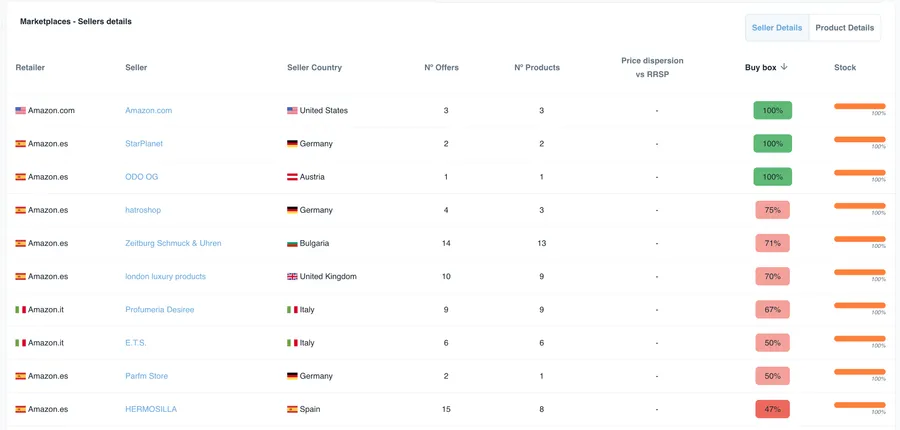
Analyse the offers for every product on marketplaces: price, availability, delivery and seller rating. Compare your offer with the market and understand the visible factors behind the Buy Box.
Offers by product
Every offer for a SKU, seller by seller, on Amazon, eBay, Miravia and more.
Buy Box
Who wins it, at what price and for what visible reason.
Selling conditions
Stock, delivery time and rating for every seller.
Qué incluye
Marketplace Intelligence, en detalle
-
Seller prices
On Amazon, MercadoLibre, Idealo and more.
-
Buy Box tracker
Who wins it and at what price.
-
Active sellers by SKU
Identified by product and marketplace.
-
Selling conditions
Stock, delivery and rating by seller.
-
Competitive history
How offers evolve for each product.
-
Alerts
New sellers or aggressive price movements.
The impact
Price matters, but it is not everything.
Stock availability, delivery time and seller rating also influence which offer wins the Buy Box. On Amazon and other marketplaces with a Buy Box, more than 80% of sales go through that button. Analyse every condition, compare against the market and decide with the full picture.
Features
Five building blocks to compete on marketplaces
Buy Box, availability, delivery, listing quality and alerts: everything that decides which offer takes the sale.
Buy Box monitoring: know who holds it, when you lose it and why, and act
On Amazon and other marketplaces with a Buy Box, more than 80% of sales go through that button. Many retailers do not know their Buy Box win rate, cannot identify which seller is taking the position from them, and do not understand the real cause behind each loss. Without that data, acting is impossible.
- Daily tracking of Buy Box ownership by SKU and market
- Cumulative Buy Box win rate with full history
- Identification of the winning seller in every loss
- Automatic classification of the cause: price, stockout, rating, delivery or Amazon 1P
Real-time stockout detection before it hits sales
A SKU with no stock on a marketplace does not just stop selling, it opens the door for another seller to win the Buy Box and take that demand. Data Seekers records stock status by SKU, seller and marketplace, accumulates days out of stock and connects every stockout event with Buy Box movements. And the other way round: when a competitor runs out of stock, you have a window to win.
- Daily availability record by SKU, seller and marketplace
- Accumulated days out of stock with % availability per period
- Direct connection between stockouts and Buy Box loss
- Immediate alerts when a SKU goes unavailable, yours or a competitor's
Delivery time monitoring by seller and market
Advertised delivery times directly affect conversion and, on platforms with a Buy Box, they are one of the allocation factors. Yet almost no team measures them systematically. Data Seekers captures delivery times on every daily crawl, by seller and by market, and presents them in a fully customisable operational performance dashboard.
- Capture of advertised delivery times by seller and market on every crawl
- Comparison across markets for the same product
- Breakdown by SKU and evolution over time
- Dashboard customised to what the team needs
PDP quality control on eBay and Miravia: attribute by attribute, seller by seller
On platforms like eBay or Miravia, each seller creates their own product listing. The result is thousands of PDPs with incorrect descriptions, missing attributes or wrong categorisations, with no centralised control system. Data Seekers extracts more than 15 attributes per PDP, validates them against the official catalogue and generates an actionable content quality score by seller, by market and by product.
- Capture adapted to the structure of eBay and Miravia (no dependency on feeds or APIs)
- Extraction of 15+ attributes per PDP: name, theme, dimensions, EAN, recommended age, category and more
- Attribute-by-attribute validation against the official catalogue (correct / incorrect / missing)
- Customisable rules engine by market, category or seller
- Drill-down from the global view to a specific attribute of a specific seller
- 25M+ data points processed with 100% coverage, no sampling
Real-time alerts and AI: the platform works for your team
Data only has value if it reaches the right person in time. Data Seekers combines a configurable real-time alert system with an artificial intelligence engine that automatically prioritises the most relevant findings each day, so the team can act without reviewing dashboards manually.
- Alerts configurable by KPI, market or SKU group
- Notifications via email, Slack or Telegram to the right owner
- Conversational AI: questions in natural language, immediate answers
- Automatic daily summary of changes, anomalies and priorities
What it includes
Marketplace Intelligence for Retailers, in detail:
Every product with all its offers, the Buy Box explained and the category movements, in one place.

How it is used
From offer analysis to a commercial decision.
It is not just about seeing that another seller holds the Buy Box. It is about knowing which condition moved it, whether price, stock, delivery or rating, and deciding where it is worth competing and where it is not. With context, not intuition.
Three steps, always in the same order, with each day's data:
- 1 Spot the differenceCompare your offer with every other seller on price, delivery, stock and rating. Every morning, for every product and marketplace, with no listings to check by hand.
- 2 Understand the condition that changesIdentify which factor explains the differences or a Buy Box change: whether the winner delivers sooner, has a better price, has stock when you do not, or adds more ratings.
- 3 Decide where to competePrioritise products and categories with the biggest opportunity given the market conditions. Sometimes the answer is to lower the price; many other times, to shorten delivery or secure stock.
The result is a short list of products where it is worth acting, and for each one, which condition to address first.
The Buy Box in context.
The Buy Box is the buy button the marketplace assigns to a single offer. Here you see three things at a glance: what share of the time your offer has held it, at what price it is being won and how the split between sellers has changed day by day.
The point is not just to see the Buy Box change hands, but to understand which visible condition (price, stock, delivery or rating) goes with each movement, so you know what to address.
A retailer found they were losing the Buy Box on their best-selling references without lowering the price: the winning seller advertised next-day delivery against their two or three days. With the history by seller and market, they prioritised improving logistics in that category instead of entering a price war, and recovered the position while protecting their margin.
For a complete view of your market, combine it with: Pricing Intelligence · Stock Intelligence
For every team
A clear view for each team.
Ecommerce Manager
Monitor your Buy Box win rate and the quality of your PDPs, and act before the algorithm penalises you.
Pricing
Decide whether to compete on price or on conditions, with the winning offer and its history in front of you.
Operations
Compare your delivery times and availability against every seller, market by market.
Lo que este módulo cambia en tu día a día
You see your offer against all the others
Price, stock, delivery and rating for every seller listing the same product, in a single panel, every day.
You understand the Buy Box, you do not just watch it
Who holds it, for how long and which visible condition changes with every movement: price, stock, delivery or rating.
You react before the market does
Alerts when a new offer appears, a price changes or a competitor runs out of stock, with no dashboards to check by hand.
FAQs
Frequently asked questions about Marketplace Intelligence
Which offers can I compare?
Every visible offer for the same product on each marketplace: yours and every seller's, with price, availability, advertised delivery time and rating. The comparison is made by SKU, market and day, and can be aggregated by category or brand.
Which visible factors are analysed in the Buy Box?
The ones the marketplace shows publicly: the price of each offer, stock availability, advertised delivery time, seller rating and whether the offer comes from Amazon 1P. By crossing those factors with the history, Data Seekers classifies the most likely cause of each Buy Box loss or gain.
Can I review price and availability changes?
Yes. Every daily capture stays in the history by SKU, seller and market, so you can see when a price changed, how long an offer was out of stock and how Buy Box presence evolved over that period.
Can I analyse a whole category?
Yes. Beyond the product view, you can see price evolution, the latest movements (new offers, price changes, stock changes) and the Buy Box split across an entire category, so you can decide where it is worth competing.
Which marketplaces can you monitor?
We monitor any marketplace with accessible public data: Amazon (all EMEA stores and beyond), eBay, Miravia, MercadoLibre, Idealo and other European or regional marketplaces depending on each client's needs. Coverage is not limited to a fixed catalogue of platforms: if you sell on a specific marketplace, we analyse it.
How often is the data updated?
The standard crawl is daily. That means every morning you have the previous day's data for all your SKUs, sellers and markets. For cases requiring greater frequency, launches, campaigns, high-demand periods, we can increase the cadence.
Do I need access to the marketplace API to get started?
No. Data Seekers works with its own capture infrastructure, with no dependency on marketplace feeds or official APIs. This matters especially on platforms like eBay or Miravia, where no API exposes third-party seller data at PDP level. We only need your product catalogue and the marketplaces and markets you want to follow.
Can I configure alerts so they reach different people depending on market or category?
Yes. The alert system is fully configurable: you can define which KPI triggers an alert, with which threshold, and who is notified, by country, by product line or by type of issue. Notifications arrive via email, Slack or Telegram.
How long does onboarding take?
It depends on catalogue complexity and the number of markets, but the standard process is 2 to 4 weeks from kickoff to the first data in the dashboard. We assign a dedicated onboarding team that supports you at every step: catalogue configuration, KPI definition, validation rules and alert setup.
Is the data exportable?
Yes. All data is exportable to Excel at any time, with full historical retention from the first day of capture. The dashboard also allows drill-down from a global market view to the detail of a specific attribute on a specific seller's PDP.
Can you monitor attributes specific to my category that other tools do not cover?
That is exactly what we are built for. The extraction and validation engine is fully configurable: we define together which attributes are critical for your category, whether dimensions, recommended age, pack contents, certifications or any other field, and we build the validation rules against your catalogue. There is no fixed list of attributes: it adapts to your business logic.
Compete with context on every marketplace.
In 48 hours we will show you a real analysis of your market.